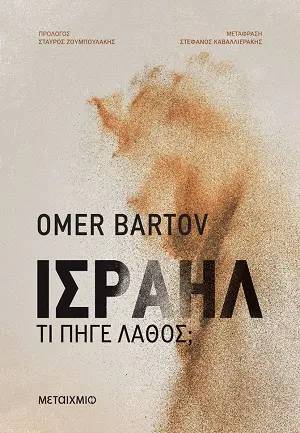
In the book, Omer Bartov outlines the transformation of Zionism, a movement that sought to liberate European Jewry from oppression, into a state ideology of ethnonationalism.
How is it possible, he asks, that a state that was founded immediately after the Holocaust and which legitimized the idea of a national home for Jews could be accused of committing large-scale war crimes?
How can we reconcile ourselves to the fact that the destructive war waged by Israel is supported, with a distance of denial and indifference, by so many of its Jewish citizens?
Tracing the roots of the violent events unfolding today in Israel and the occupied territories, Bartov examines the origins of Zionism, the connection of Israeli independence to Palestinian displacement, the political use of the Holocaust, the controversies surrounding the term “genocide,” and the uncertain future. A sharp and insightful critique that intervenes in contemporary discussions about Zionism and the future of Israel.
Things are worse today than at any other time in the history of Israel as an independent state […]. In this grim condition, Bartov does not give up on discussing what the solution to the drama might be. He considers the proposals for either two states or a binational state to be unworkable and subscribes to Dalia Seidlin’s proposal for a confederation of two sovereign nations and distinct states, with their own governments, institutions and borders, freedom of movement and, above all, inclusive citizenship […]. The capital of the two states is Jerusalem, which will remain an open city for all religious and national communities. As much as today’s reality makes, in the eyes of realists, […] such a discussion ridiculous, I believe that it must be kept alive, in order to keep hope alive.
Από τον πρόλογο του Σταύρου Ζουμπουλάκη